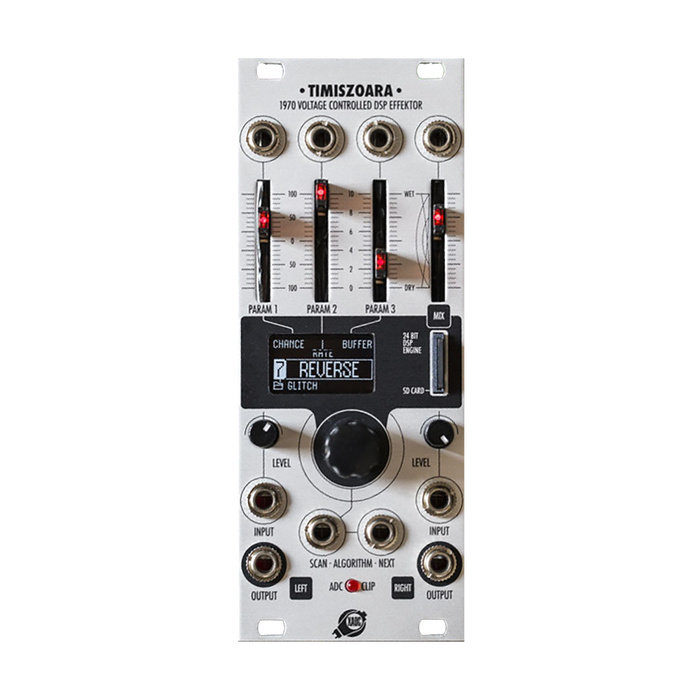
MUSICAL FEATURES
Timiszaoara is a voltage-controllable stereo multi-effects processor for Eurorack.The Spin Semiconductor's FV-1 open architecture in use allows you to add custom-designed effect / feature algorithms, organize them into virtual cartridges on microSD cards, and use them in library format.
- Voltage control of up to 3 parameters for each algorithm
- Analog dry / wet mixer with low noise design and voltage control
- OLED screen with excellent visibility
- Equipped with MicroSD card slot on front panel
- Select algorithm with voltage control
HOW TO USE
Interface
The explanation of each part is displayed by mouse over
MENU NAVIGATION
In normal operation, it is currently loaded by turning the encoder.Up to 8Select an effect program from the program bank.

-
A: The location number of the program in the bank
-
B: program name
-
C: Three parameter names of the program
-
D: Icon indicating that the program is currently active
-
E: Current bank name
The program is only loaded by clicking on the encoder to confirm your selection.By pressing and holding the encoder for 1 second, each folder displays the contents of the memory card as a list of folders corresponding to one bank.

- F: Icon indicating that the bank is currently active
- G: Enter the bank
- H: Fixed Spin FV-1 built-in bank
At the end of the list is a Cancel option, which, when selected, will return you to the last loaded bank. Confirm your selection by clicking the encoder. If no SD card is inserted in the slot, only two options are available: SPIN DEMO and CANCEL . SPIN DEMO, the built-in bank of the Spin chip, is also available from cards inserted into the module. The programs contained in this bank are nothing special, but they can be useful in emergencies such as a faulty or lost memory card.
A specific bank is selected and confirmed by clicking the encoder to load the bank into memory.You can also remove the card to access all eight programs in the loaded bank.
CV Controls
The three parameters of the selected effect program can be controlled manually or by patching CV to the input jacks located above each corresponding PARAM slider. These CV inputs can accept a 10Vpp voltage, sweeping the parameters across their full range when a ±5V LFO is received with the sliders set to the center position. Similarly, when the sliders are set to their minimum values, applying a 10V envelope will sweep the parameters across their full range. The same rules apply to the MIX slider and CV inputs .
To select a program from the current bank, use the rotary encoder or an external CV or trigger signal. A trigger signal patched to the NEXT input acts the same as clicking the encoder by turning it clockwise. This loads the next program in the list and automatically confirms it. This list is arranged in a loop, returning to the first program after the eighth. By patching a voltage to the SCAN input, you can shift forward or backward (to the next or previous program) from the currently loaded program. This SCAN input accepts voltages in the range of -5V to +8V, and each 1V change switches the position above or below the current position.
NOTE: The FV-1 chip takes a little time to load a new program and reinitialize, so it cannot scan for programs instantly.
File Structure & Naming
Timiszoara allows you to add effect programs using the factory card that came with your module, or another card.Format your new card to FAT16 or FAT32.Effects must be written in the assembly language of the FV-1 chip, or visually designed using SpinCAD Designer and compiled in binary format (for example, using the ASFV1 compiler).Also, considering hardware restrictions, the number of instructions in each program should be 128 or less, the internal registers should be 32 or less, and the delay memory should be 32768 words or less.
NOTE: Clockface and Xaoc Devices do not provide technical support for third-party software.
In Timiszoara, each compiled binary (a bank of eight programs) is placed in a separate folder with the same name, with the names of all eight programs and their three parameter names separated by commas.The text file (without spaces) must be associated.
Each effect program can contain three PARAM sliders and up to three parameters controlled by the corresponding CV input.The bank name and each parameter name should be up to 3 characters long. When preparing a custom file for Timiszoara, it's a good idea to follow the structure and naming rules of the factory file.
Factory Programs
The microSD card that comes with Timiszoara has a factory program that covers various effects such as delay / reverb / modulation / filter / pitch shifter / distortion / glitch / stutter.Many of these effects consist of two nearly independent signal paths and are performed in stereo.However, some effects benefit from using a single signal path for most resources.In such cases, the program downmixes the stereo signal to monaural before performing any processing.Note that the total memory of the FV-2 chip only allows a delay of 1 second, so it must be split between channels.Also, some of the included combo programs have different effects for each channel.
Factory Program Highlights
-
GLITCH: Includes algorithms that emulate glitch behavior that triggers various glitches such as CD skipping, bit reduction, dropouts, and other digital signal degradation.
-
DECONSTR & RECONSTR: It means dismantling and reconstruction, respectively, the former destroying the signal violently and the latter creating a soundscape based on it.The feedback path, extreme gain values, and oscillations that respond to the dynamics of the input audio are cleverly interwoven.
-
REVERBS2: A bank of reverb effects with a twist.These programs offer a wider size and modulation than the regular programs contained in the REVERBS1 bank.
-
PARALLAX: A bank of delays with two parallel delay lines with different feedback paths, providing a taste of different time operations.In addition to the usual controls such as delay time and feedback, Parallax Delay has a third parameter called Skew that allows you to adjust the mutual temporal displacement of the two delay lines.
-
RESONATOR: A set of resonator algorims covering a wide variety of types, from subtle to extreme, including filtered, unfiltered, single voice, and minor / major chord variations.
-
RINGMOD: It covers not only the original function of ring modulation, but also control by envelope follower, modulation by LFO, 2-band, Mid / Side, and cross modulation.
Expandability
With the planned release expander, you can add two feedback loops with CPU clock control and a tone processor.