MUSICAL FEATURES
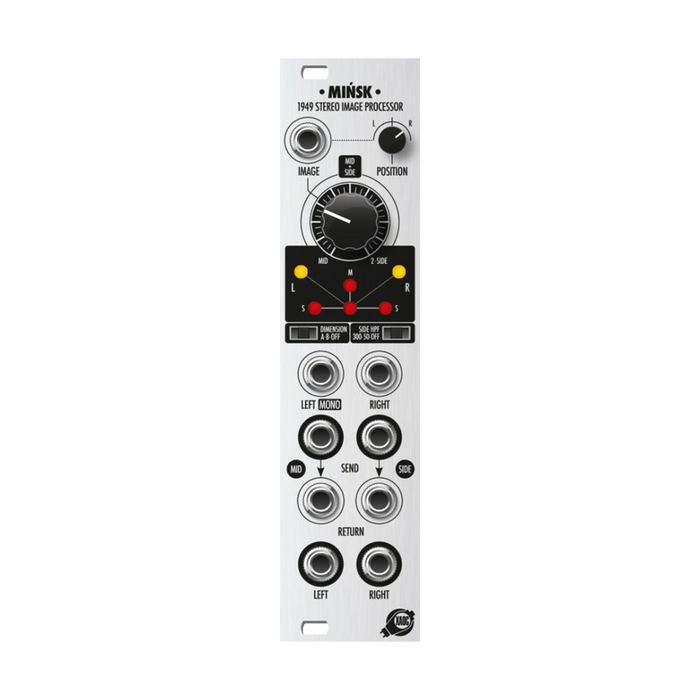
Xaoc Devices Minsk is a hybrid stereo image processor that combines digital and analog processing to provide advanced Mid / Side operations for stereo signal pairs.This unit can handle both the mid and side components individually, which affect the depth and breadth of the auditory image.The stereo width can be controlled with both the knob and CV, and the existing stereo image can be emphasized. It also has a two-dimensional effect that allows you to create a pseudo-stereo image based on a stereo or monaural input source.
- Stereo image manipulation tool
- Mid / Side processing
- Create a pseudo-stereo signal from a monaural signal
- Stereo Dimension Enhancement
- Manual and CV control of stereo width
- Low cut of Side component
- 6-LED indicator to visualize stereo image
HOW TO USE?
Interface
?
The explanation of each part is displayed by mouse over
Mid / Side processing
The principle of M / S processing is simple: the M signal is obtained by scaling the sum of the left and right signals, and the S signal is obtained by scaling the difference between them.Precision is required to accurately cancel components that are the same but out of phase.Interestingly, if you apply the same sum and difference to M and S, everything is undone.This will eventually allow you to return to LR. The M / S representation does not magically separate the centrally located sound from the off-axis sound. The S signal contains only the components of the audio signal that are out of phase on the left and right channels and are canceled when they become monaural.This mainly represents the part of the stereo signal that is distinguished from monaural audio.If the sound is extremely panned, that is, it is only present on either the left or right channel, it will be equally divided by 50% on the M channel and 50% on the S channel.By separating the Mid and Side information, this unit can apply effects such as dynamics processing and equalizing independently to the depth and width of the auditory image.In addition to these special effects, the important advantage of this unit is that the Mid and Side signals can be processed individually or in completely different ways to maintain the balance and symmetry of the entire image. You can do it.
Dimensional effect
Minsk has two ways to add stereoscopic effect to an audio signal, one is to emphasize existing stereo pairs and the other is to create a pseudo-stereo image from a monaural signal patched to the LEFT / MONO input. You can use the method. Based on the Haas effectDIMENSION AIntroduces a short, very slow-changing delay between the left and right channels.Such delay changes disrupt the human auditory system, which relies on the interaural time difference in identifying sound sources in the stereo field.In reality, it transforms into a delicate animation of a stereo image with constant movement.DIMENSION BIs based on the early reflections found in many reverb spaces.In recording technology that uses multiple microphones to capture an acoustic scene, the perception of size depends primarily on the presence or absence of wall reflections.This unit uses the algorithm reverb ER network to simulate this effect, and the output is mixed with the Side signal.IMAGEAdjust the degree of size with the control.
Low-cut filter (Side HPF)
Removal of off-axis low-end components is a process often required for record cutting, etc., and this unit facilitates this process by applying a high-pass filter to the S component.SIDE HPFThe switch has three levels of 300, 50, and OFF, with a 3dB / Oct filter slope at 300Hz and a steeper 12dB / Oct slope at 50Hz.Note that this filter does not affect the M component, so unless it is a very eccentric mix, it will have little effect on the timbre balance.
Stereo image width control
IMAGEThe knob and associated CV input control the width of the stereo image by applying variable gain to both the M and S components. When there is no CV input and the knob is in the center position labeled MID + SIDE, this control has no effect on the signal.Turning the knob to the left reduces the amplitude of the S component, narrowing the perceptible image closer to monaural.Turning the knob to the right of the center increases the amplitude of the S component and at the same time reduces the gain of the M component, maintaining the energy of the entire signal.This artificially expands the stereo image and at the same time creates a space in the center of the image. 2 When the knob is set to the maximum value labeled by SIDE, there is no M component and only the S component, and the phases of the L and R signals are completely out of phase.This setting should be done with caution, as such signals do not support monaural playback and can sound unpleasant on many PA systems.IMAGECVIf the input is patched with CV, the IMAGE knob acts as an offset. When the IMAGE knob is in the center position, a bipolar ± 5V signal is required for full range modulation.Also, when the knob is set to the minimum MID, bipolar modulation causes the S component to change beyond zero, resulting in stereo image mirroring (LR inversion).
Symmetry control
If the final stereo output is tilted,POSITIONYou can manually adjust the left-right balance using the knob.For accuracy, the operating range is limited to + 2 / -12dB.
Goniometer
A stereo image indicator consisting of six LEDs arranged vertically, horizontally and diagonally plays an important role in identifying potential signal problems.For proper stereo signals, all 6 LEDs will be lit or flashing.If the horizontal LED pair remains dark, the important component of S is absentIt means that the signal is very narrow in mono / stereo image.If the two LEDs in the vertical direction are dark, it means that the channels are out of phase.Two diagonal yellow LEDs indicate the intensity of the final LR output (after symmetry adjustment).
Signal level
In general, Eurorack equipment does not have enough headroom, which can cause clip distortion when mixing two high-amplitude signals. Minsk guarantees safety by performing the L / R to M / S conversion at 2/1 scaling, but be aware that the IMAGE control introduces up to twice the gain in the S component. is.This will cause distortion if the original L and / or R signal is out of phase by more than 2Vpp.On the other hand, the conversion from M / S to L / R does not scale.This part is a complete analog circuit and may clip if the M and S signals patched to each input exceed 2Vpp.Also, extreme symmetry correction may cause distortion due to additional gain.You can maintain audio quality by always paying attention to the amplitude of the input and output signals.