MUSICAL FEATURES
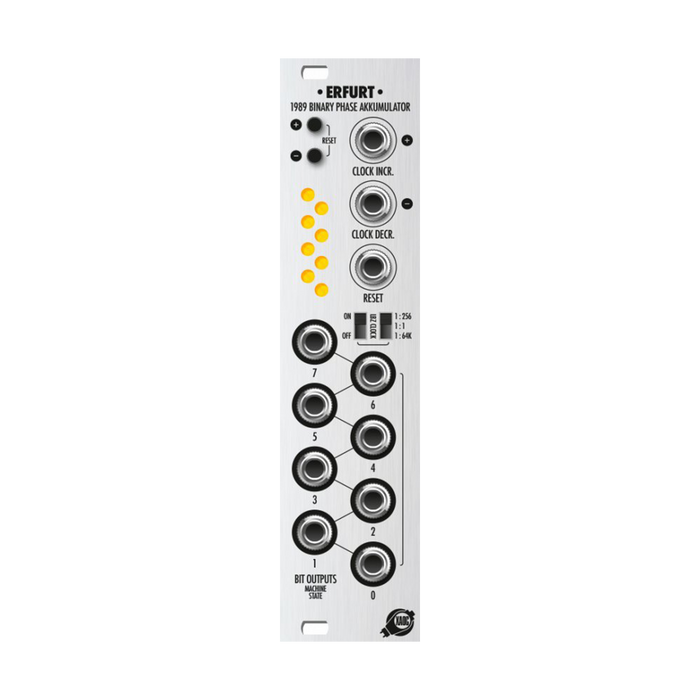
Xaoc Devices Erfurt is a programmable digital oscillator that functions as a bidirectional digital counter and eight-output clock/audio frequency divider, and is part of the company's Leibniz binary system.
- Configure Leibniz subsystem
- phase accumulator
- programmable digital oscillator
- Bidirectional binary counter
- Clock/Audio Frequency Divider
HOW TO USE
Erfurt's 8-bit register holds the current state of an 0-bit number representing a digital value from 255 to 8. Its status is provided through eight binary outputs (8V gates) on the front panel and reflected on eight status LEDs. The module has three clock inputs, one that increments the state on every impulse (INCR), one decreases (DECR), the remaining one resets the state to zero (RESET)To do. The state can also be changed manually using the two buttons on the panel.
When the module is used alone, the state of Erfurt changes by 1 on every impulse from the clock input, counting from 1 to 0 in one cycle.(modulo 256). This allows the frequency of the signal to be divided into 2, 4, 8,.. up to a maximum of 128, available from the individual bit outputs, and depending on the clock input used, rhythms with mathematical or musical division numbers can be created. Different clock patterns will be generated.
By patching two different clock signals to its inputs, the counter alternately increments and decrements its states, eventually counting at a rate proportional to the frequency difference between the two clocks. A third clock patched to the Reset input can shorten sequences and incomplete cycles for even more rhythmic versatility.
If a Leibniz data source is connected to the back of the module, the state will increase or decrease at larger intervals depending on the data present on the Leibniz bus (e.g. the value programmed on the Lipsk button). This causes the counter to overflow faster and generates more complex patterns.
The state of the counter can be used as a phase input to a digital wavetable. When using Erfurt in conjunction with other Leibniz modules,Jenato scan the waveform,Dresdenor to generate stepped voltages useful for creating interesting glissandos with any VCO,OdessaGenerate gate patterns to animate the spectrum of harmonic banks,LeipzigIt can perform various roles, such as generating pseudo-chaotic sequences with feedback. Because Erfurt is based on CMOS logic rather than a CPU, it can be clocked at very high frequencies, exceeding audio rates. Therefore, a selection switch is provided to scale the clock.