
Skip
Free domestic shipping over 15,000 yen | FREE DHL SHIPPING WORLDWIDE FOR ORDERS 50K+ yen : Details

Buchla & Tiptop Audio 266t Source of Uncertainty

¥49,900 (Tax excluded ¥45,364)
The core random module of the Buchla system with advanced controls such as distribution control

Format: Eurorack
Width: 24HP
Depth: 25mm
Current: mA @ + 12V, mA @ -12V, mA @ + 5V

* The Buchla & Tiptop Audio series is a Eurorack module of the Buchla 200 series.The following points are different from the original Buchla so that it is easy to use with Eurorack.

--All 3.5mm mono jacks (use the usual 3.5mm TS mono cable for banana nut jacks)
--Pitch CV for scale is 1V / Oct
--Audio is 10Vpp, equivalent to Eurorack
--CV is 0-10V

MUSICAL FEATURES

 Buchla & Tiptop's "Source of Uncertainty" 266t is Buchla's classic random generator module. Six different tools are housed in one module.

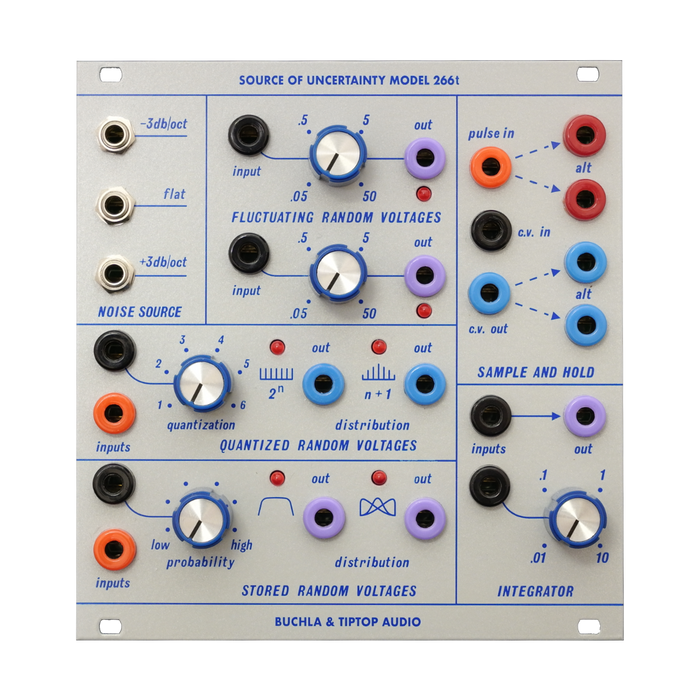
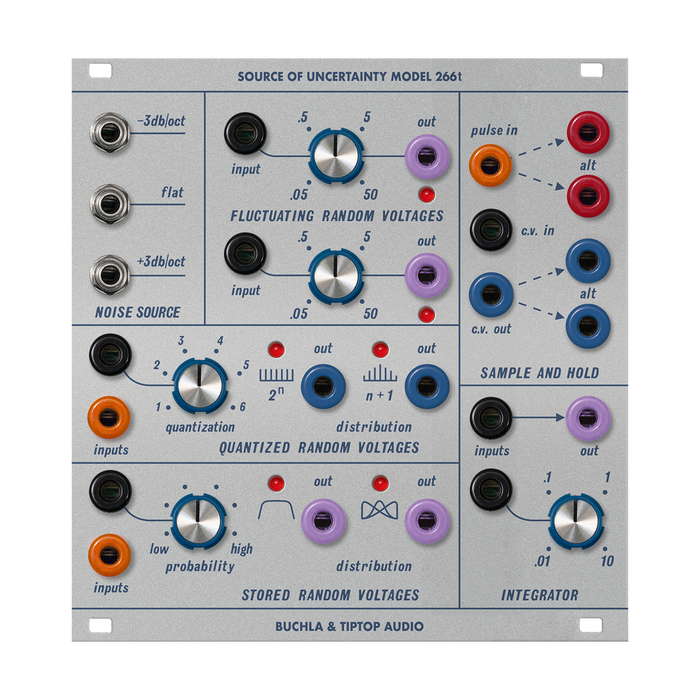
Following the noise section, which features three types of noise: white, pink (-3dB/oct), and brighter noise (+3dB/oct) , the Fluctuating Random Voltages section consists of two smooth random voltage generators, with the Rate parameter controllable via a knob and CV. Below that is the Quantized Random Voltage section, which outputs a random voltage from the two jacks on the right each time it receives a gate from Pulse. The difference between the two outputs is the possible voltage values ​​of the random voltage: the "n+1" output can take n+1 values, and the "2^n" output can take 2 squared values. n can take a number from 1 to 6 and is controllable via a knob and CV. The last random generator is the Stored Random Voltage section, which outputs stepped voltages similar to the Quantized section, but is characterized by its ability to produce random voltages following a bell-shaped distribution that can be controlled via a knob and CV.

The upper right section is the Sample and Hold section. There are also two additional outputs, which perform sample and hold using a signal (flip-flop) that is switched ON/OFF alternately by a gate signal to Pulse In. Finally, there is the Integrator section, which is a so-called slew limiter/lag processor.

With such a wide variety of functions, it is possible to output extremely complex random voltages by making full use of patching inside the module as well as modulation to other modules. 


Interface

 
The explanation of each part is displayed by mouse over


Top
x