MUSICAL FEATURES
Jeweler Cast is a true ripple master that melts, bends and sculpts any type of signal, audio or CV. Consisting of two separate sections, the Mix section and the Shaper section, Jeweler Cast combines a ring modulator, crossfader, wavefolder and distortion.This all-analog, compact module lets you manipulate basic waveforms and complex signals in endless ways with an ensemble of tools.
HOW TO USE
Mix section
 Mix potentiometer A is a compound crossfader that blends three different sources.
The center position is the signal inserted into Input 1.When turned clockwise from the center position, the potentiometer will crossfade between Input 1 and Input 3.Turning it counter-clockwise from the center position will crossfade between Input 1 and the result of the ring modulation between Input 2 and Input 1.The ring modulator is diode-based and offers a more vintage sound than the classic four-quadrant multiplier.

Simply put, the left-hand range of the potentiometer is for adjusting the dry/wet state of the ring modulator, and the right-hand range is for crossfading the signal. Input 3 is normalized to Input 2 for easier patching. The Mix parameter can be controlled by CV 3 , and there is an attenuator C for setting the amplitude and phase of the control signal .
Shape section
This section is normalized to the output of the Mix section. It has two modes, 'Distortion' and 'Wavefolding', which can be selected with the Shape switch D. When turned all the way counterclockwise, Shape potentiometer B provides a completely dry signal. Distortion is something between overdrive and clipper. Potentiometer B crossfades the dry and distorted signals while adding more gain. At its maximum value when turned clockwise, it converts any waveform into something close to a square wave.
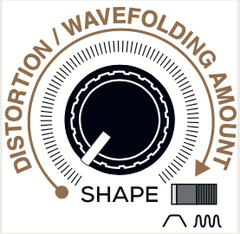 A wavefolder is a 6-level serial folder.Low settings will overdrive any signal with slightly added harmonics.Higher settings are best for subharmonic signals such as sine waves and triangle waves.
The shape parameters in the Shape section can be controlled by CV via Shape CV input 4 and attenuated by the Shape CV control attenuator E. Both modes in the Shape section can deform the signal, but they are designed to work most effectively with a 10Vpp signal. When using an external signal, use a gain module upstream.
AC switch
The module supports DC components and very low frequencies by default, enabling mangling of CV signals. The ring modulator acts as a multiplier for CV signals, the Mix section provides crossfading between modulation sources, and the Shape section allows for easy deformation of LFO waveforms. However, when dealing with audio range signals, it is recommended to turn on the AC switch F to remove the DC component from the output. This also yields better results when you want to ensure feedback patches or that the voltage is within the -5 to +5V range.
Patch ideas
Jeweler Cast was originally designed for mixing and processing two VCOs.A few knobs can merge, ring modulate, distort or distort the VCO's output without changing the patch.But you don't have to limit yourself there.Below are some ideas to get you started.
Dry wet folding:
Wavefolding produces a great sound, but it tends to emphasize the highest parts of the spectrum and strip out fundamental frequencies, sucking the life out of low-end sounds.To solve this, send a sine wave to Input 1 of the Mix section and the Shaper section and transform the waveform in Wavefold mode.Then send the output of the Shaper section to input 3 of the Mix section and monitor the output of the Mix section.This allows you to get a sound that blends the higher harmonics of the wavefolder with the fundamental frequency.
AM-ring modulation combo
AM (amplitude modulation) and ring modulation are techniques in electronic music synthesis for combining two input signals to create new sounds. By modulating the CV control at audio rate, you can get the effect of a combination of AM and ring modulation. Use three different waveforms and send the first waveform to input 2 of the mix section, the second waveform to input 3, and the third waveform to CV Mix.Set the mix potentiometer to the 1 o'clock position and the mix CV potentiometer to the 2 o'clock position and listen to the Mix Out.
Ring modulation with dry and wet signals
Combining Dry and Wet Signals with Ring Modulation: Create an original waveform by sending the waveform sent to Input 1 and the same waveform processed by the Shaper section to Mix Input 2 using the Ring Modulator can.
Simple VCA
The Mix section can be used as a simple linear VCA if only input 1 is used. Turn the Mix potentiometer fully clockwise and its attenuverter fully counterclockwise between noon to modulate the mix parameter based on the CV source.