



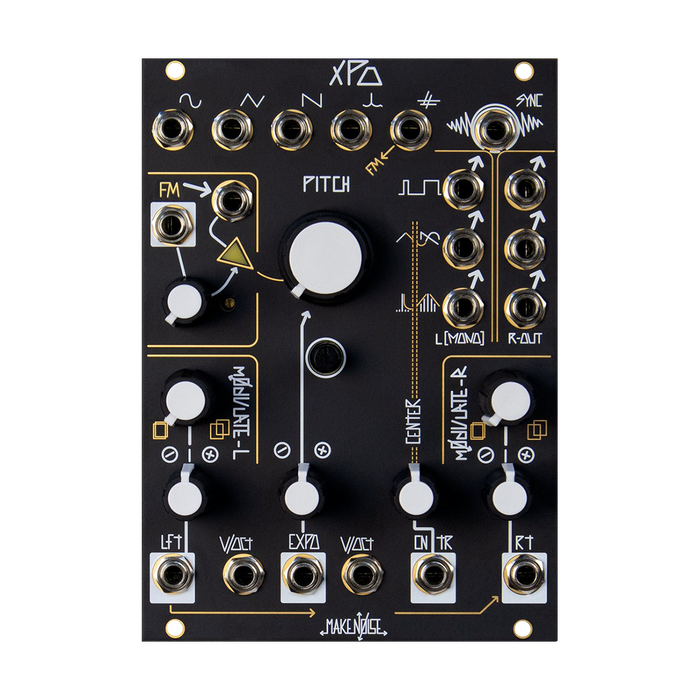


Make Noise XPO
¥73,900
(Tax excluded ¥67,182)
Full analog VCO with modulation options that are effective even in the stereo field
The XPO (Stereo Prasmatic Oscillator) is a fully analog stereo oscillator. In addition to basic waveforms such as sine, triangle, and sawtooth waves , it provides spike waves and a subwoofer output, stereo timbre modulation including stereo PWM and wavefolding, frequency modulation, and unique oscillator sync in the analog domain.
XPO shares a common philosophy with QPAS , where complex circuits are controlled from multiple angles within the stereo field by several powerful parameters, and therefore has a high degree of affinity with it.
At the top of the XPO are five mono waveform outputs derived from the oscillator core.

A sine wave isDPOandSTOis shaped from a triangular wave identical to that of the circuit that implementsSawtooth, spike, and sub outputs are new for XPO.These outputs are useful for applications where they are individually processed through VCAs, filters, etc., like conventional VCO outputs.They areOPTOMIX,X-PANIt can be mixed using a mixer such as , panned to any position on the stereo output, or used as a tonal modulation source to modulate the XPO's own Center and Modulate parameters.It can also be used as audio rate modulation to processors like QPAS running on the output of the XPO, always showing the same frequency on all outputs.
On the right side of the XPO are three pairs of stereo outputs derived from the oscillator core.These outputs are QPAS andMimeophonProvides an excellent audio source for stereo processing modules such as
All output pairs receive tonal modulation from the Modulate L/R parameters, and are available mono through their respective Left outputs when there is no patch on the Right output.
Note that the Vari-Timbre and Folding outputs receive timbre modulation from the Center parameter on both LR outputs.

The Pulse Width Modulation output continuously modulates the width of a square wave using a classic PWM circuit. The Modulate control is 0% (silent) at its minimum value, 50% (square wave) around the 12 o'clock position, and approximately 99% (very thin pulse) at its maximum value. Using a control voltage, the pulse width can be increased up to 100% (silent again).
Pulse width modulation can alternate between even and odd harmonics. The XPO has two independent PWM parameters for the two outputs, so you can listen to interesting combinations by monitoring in stereo and modulating both sides with the same period and modulation amount, or different values at the same time. increase.
Left and Right, each PWM output is independently controlled by the Modulate control. If the Right output has no patch, the Left output will give the sum of the Left output and an inverted copy of the Right output.If you use only the Left output for a mono signal, you can get interesting fading behavior by modulating one or both waveforms.

Vari-Timbre is derived from sine, triangle, and sawtooth waves. The Center parameter, which crossfades both the left and right Vari-Timbre signals from sine to sawtooth, is a feature found in the circuits of classic West Coast synthesizers such as the Buchla 158 and 258. This can also be used in a way similar to a low-pass filter, changing the sound from smooth and soft to sharp and bright. The resulting Sine/Saw shape is further processed by the Modular L/R parameter, which cuts the triangle wave into the waveform defined by the Center parameter (Sine/Saw). The minimum value is 0%, approximately 50% at the 12 o'clock position, and the maximum value is 99%, and the presence of the triangle wave can be increased up to 100% using the control voltage.
The Left and Right Variable outputs are independently controlled by each Modulate control. The Center parameter behaves identically for both outputs.
If the Right output has no patch, the Left output will give the sum of the Left output and an inverted copy of the Right output.If you use only the Left output for a mono signal, you can get interesting fading behavior by modulating one or both waveforms.The effect of the Center parameter when in mono tends to be more subtle due to more phase cancellation in the center of the generated waveform, but can still result in strong overtones when modulated at audio rates. I have.

The wavefolding output utilizes a circuit similar to the DPO's final output and the 0-Coast 's multiply circuit.
When modulated at its minimum value, the wavefolder gain is sufficiently low that the output is functionally silent. Increasing the value of Modulate L/R causes the waveform to appear and then collapse onto itself.The number of folds increases from zero to five through the operating range of each Modulate L/R parameter. The Center parameter modulates the shape of the waveform sent through the wavefolder, as well as the folding point.The lowest parameter value produces the simplest saturated sinusoidal wave, while the highest value produces a series of light, crisp spikes.
Left and right Folded outputs are independently controlled by the Modulate control. The Center parameter behaves identically for both outputs.
If the Right output has no patch, the Left output will contain the combined signal of the left and right wavefolding circuits.If you use only the Left output for a mono signal, you can get interesting fading behavior by modulating one or both waveforms.

The two 1V/Oct inputs are used for pitch control and sequencing of the XPO via a sequencer or keyboard. These are factory calibrated to track 1 volt per octave, making them ideal for sequencing with 1V/Oct quantized CV sources like Rene , or unquantized analog voltage sources like 0-CTRL . The two 1V/Oct inputs, combined with the large Pitch knob and FM input, determine the oscillator frequency in all situations. The second 1V/Oct input is very useful as a transpose input or an additional exponential FM input.

The Exponential FM input can be used for vibrato, audio-rate FM, pitch envelope, or synchronous sweep, and features an attenuator that functions as an application amount and polarity control.

The Linear FM input is ideal for audio-rate FM via other VCOs, high-speed cycling functions from MATHS , or self-patched XPOs. This input is normalized to a variation of the Sub-oscillator output, allowing for the creation of superimposed subharmonics without mixing the Sub-oscillator with other waveform outputs.
FM Depth is a parameter that sets the amount of linear FM applied and can be controlled by voltage via the accompanying CV input. Dynamic FM is effective for creating dynamic harmonic profiles controlled by voltage, and can produce a variety of sounds, from very rich harmonics to simple, harmonically neutral sounds. The input attenuator is a multi-function knob that functions as a panel control and, if a patch is present, also acts as an attenuator that scales the incoming CV. The status of FM Depth is indicated in red via the FM Depth Activity Window . Note that even if there is no patch on the Linear FM input, the FM Depth control remains active and controls the amount of FM from the XPO's Sub-oscillator.

The XPO implements a unique Sync circuit. The XPO attempts to match the frequency of the incoming signal to the Sync input. This means that all of the XPO's pitch/frequency controls also effectively become timbre controls. This sync circuit can be described as a "medium sync." Compared to "soft sync" with less resetting and "hard sync" with constant resetting, it allows for a wider range of oscillator resets, creating a ripple effect as the pitch of the sync source sweeps. From the XPO's output, you can hear the 'peaks' of hard sync and the 'valleys' due to the lack of resets.

The PWM , Vari-Timbre , and Wavefolding stereo output pairs are each uniquely affected by the Modulate L/R controls. In all stereo pairs, Modulate L acts only on the Left output, and Modulate R acts only on the Right output. When using only the Left output jack, both outputs are mixed to create a mono signal, which is affected by both the Left and Right Modulate controls. Each Modulate control has a knob and an attenuator, and the Modulate L input is normalized to Modulate R. This makes it possible to modulate both sides using a single CV source to Modulate L, with the modulation depth and polarity set separately using the respective knobs and attenuators.

The Center parameter is a combo knob that functions as a panel control or, if patched, as an attenuator for the incoming CV. This parameter affects the Vari-Timbre and Wavefolding outputs in various ways.
In the Vari-Timbre output, when Modulate is at its minimum value, Center performs a crossfade from a minimum sine wave to a maximum sawtooth wave. The resulting shape is used to 'feed' the Vari-Timbre parameter at higher Modulate values. Note that when patching only the left Vari-Timbre output for mono use, the interaction of the two outputs tends to make the Center parameter in a low-frequency modulated mono Vari-Timbre more sensitive. This makes it an excellent source for audio-rate modulation as it does not create pitch bend even at maximum application.
In Wavefolding , the Center parameter adjusts the shape and angle of the waveform sent to the left and right wavefolders as the Modulate control value increases. The resulting sound will be bright and light, or dark and rich, at various points in the Center parameter value.