



Interview with Designers: Pikamachi (Hikari Instruments)
Pikamachi of Hikari Instruments, a leading garage modular manufacturer in Japan, talks about the past and future.
2026-Jul-13
Founded in 2014, Hikari Instruments has continued to release products primarily focused on analog modules and chaotic-sounding standalone devices, and has now become one of Japan's leading modular synth manufacturers . We interviewed CEO Pikamachi about the secrets behind their design and their future prospects!

Could you tell me when and how Hikari Instruments started?
I've always loved equipment, and I used to perform live using old drum machines and effects pedals. Even back then, I preferred using equipment from before the age of MIDI, and I synchronized my drum machines using DIN SYNC.
However, DIN SYNC standards vary by manufacturer, and sometimes the speed is halved. To compensate for this, I was using a KORG KMS-30 to halve the clock, but I couldn't double it. While searching for a way to do this, I learned that modular synthesizers can easily double the clock.
Around that time, I was friends with Nomoto, who was still in a band, and he was performing at a modular synth event, so I went to the first Tokyo Festival of Modular , held in 2013. There, I witnessed the many garage manufacturers and the potential of Eurorack modules, which was a great source of inspiration for me.
That's what got me thinking about starting with modular synthesizers, but I was surprised to learn that cases and power supplies cost tens of thousands of yen. At the time, I was buying equipment for a few thousand yen at Hard Off (a second-hand store), so I just couldn't accept spending that much money on parts that didn't even produce sound.
That's when I thought, "Maybe I can make one myself," so I borrowed a complete modular synth set from Mr. Nomoto, studied it, and made my own case and power supply. Following that, I also made a sequencer, which I had wanted for a long time, and created the Analog Sequencer.
I had been quietly uploading the modules I had made to social media, and thankfully, Ben from MatchingMall contacted me saying he wanted one, so I started small-scale production. Around that time, Rintaro from CLOCKFACE also reached out to me, saying, "I'm starting a modular synth shop, would you like to sell some of my products?" Also, Miyaji Gakki had just started handling modular synths, so I think it was a time when the scene was just beginning to expand.
Just then, I learned about the 2nd Tokyo Festival of Modular, and since I had met Dave, one of the organizers, at a live show before, I asked him, "I'm thinking of starting to sell some products, would it be possible for me to exhibit?" He encouraged me, saying, "We support new manufacturers, so I'd love for you to participate."
And that's how it all began, when we exhibited at the 2nd Tokyo Festival of Modular in 2014 as Hikari Instruments.
How did you learn about circuit design and soldering?
I majored in mechanical engineering in the Faculty of Engineering at university, and afterwards I got a job at an electronics manufacturer where I was in charge of enclosure design, not circuit design. I learned circuit design on my own by researching circuit diagrams on the internet and asking for help from people around me.
I learned soldering at my previous company because there was a strange rule that "all engineers must be able to do it."

Please tell me how to work in the office. Is there anyone else to help?
I started Hikari Instruments because I wanted to create products the way I liked, so I basically do it all by myself. In the early days when I was making digital products, I sometimes got help with software from knowledgeable friends, but now I basically do it all by myself.
However, I sometimes have my children help with simple tasks like attaching caps, and my wife occasionally gives her opinion on the design.
I outsource PCB manufacturing and SMT (surface mount component mounting) to Chinese companies, and have Japanese companies manufacture the panels. After that, I handle the manual soldering of components, assemble them into panels, and then perform inspection, packaging, and shipping myself.
Please tell me how you work on weekdays and what your typical day looks like.
I spend my mornings working with relatively high concentration, soldering, assembling, inspecting, and packaging products that are running low on stock. It's like a "one-person factory." My childhood dream was to become someone who builds plastic models, so it feels quite similar to that.
Because I do a lot of detailed work, I have terrible shoulder pain, so I take walks in between, and in the afternoons I also do ordering parts and accounting tasks.
The process involves designing and developing new products in between manufacturing existing products.

That's an amazing CD collection! Do you still buy CDs? Could you tell me about some of the music that has influenced you?

My CD collection keeps growing, so I'm having trouble finding space to store them. Even so, I keep buying more, so I'm desperately trying to make storage work by throwing away the plastic cases and making the CDs thinner.
I think subscriptions are the mainstream these days, and I use them to find new things, but if I really like something, I want to own it as a physical item, including the jacket.
There are too many musical influences to list, but some that come to mind right now include Nobukazu Takemura, Boredoms, David Tudor, CHAOS UK, Beastie Boys, and BUCK-TICK.
What was the most challenging product to complete?
It's hard to say if it's the best, but Duos is a product that went through a lot of trial and error. We reviewed the functions, the number of knobs, and their placement many times.
Initially, it was made entirely of sliders, like the Monos, and didn't have a large knob in the center. However, my wife liked the knob, so we eventually settled on the current design.
What was the most memorable thing that happened when you started the company?
It's difficult to pick just one thing, but receiving requests from artists and having them use my products is particularly memorable.
In particular, I have vivid memories of working with Keiji Haino, whom I've admired for a long time, to create a synthesizer, and of being asked by world's end girlfriend to make it possible to connect a guitar to the Duos. I'm truly happy to be able to interact with people I wouldn't have met if I hadn't been a manufacturer.

Could you tell me about Hikari Instruments' characteristics and goals?
We focus on creating something that is "simple yet interesting" and "simple yet profound." We also pay close attention to the placement of the knobs so that they can be operated intuitively during live performances. The reason we use so many sliders is not just because we like the look of them, but also because their positions are easy to understand at a glance and it's easy to operate multiple sliders simultaneously with just one finger.
Furthermore, we intentionally include features whose usage isn't fixed to just one point, leaving room for users to decide how to use them.
Furthermore, we place a strong emphasis on design, sometimes even changing component selection, placement, and functionality based on the panel design. This is possible because I handle everything from product planning and material procurement to circuit design, mechanical design, and assembly all by myself, something that would be difficult in a typical company where departments are separated. I believe this flexibility is a strength of a garage manufacturer.
Are there any modules you'd like to create in the future?
I've been thinking about various things, such as VCOs, but I might change my mind, so I'll leave it at that for now.
Could you please give some advice to someone who is just starting out with modular synthesizers?
I recommend starting by buying just one module and trying it out.
From there, I think it's best to think about "what you need next" and gradually acquire those items.
For example, you could buy a filter and connect it to your existing rhythm machine to play around with.
Next, if you want to "modulate" something, you can add an envelope or LFO.
Naturally, the system expands as you realize you need a sound source, then a VCO, then a sequencer, and so on.


Hikari Instruments Recommended Eurorack Modules
-
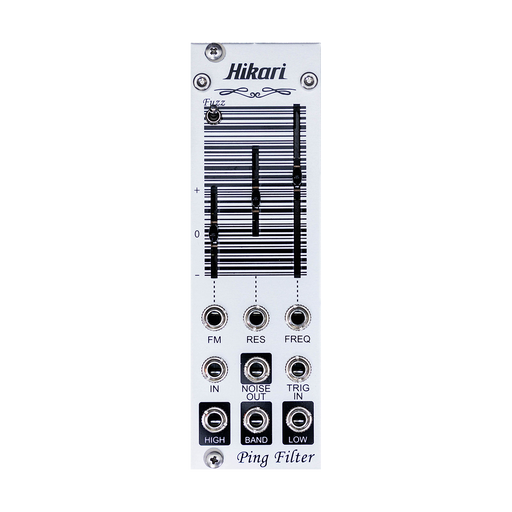

Hikari Instruments Ping Filter
In Stock¥25,300 (Tax excluded ¥23,000)Equipped with a unique Fuzz mode. 2-pole multimode filter with smooth Ping soundThe MUSICAL FEATURES Ping Filter is a 12dB/Oct (2-ball) multi-mode filter module. Equipped with convenient white noise output in addition to high pass, band pass, and low pass outputs that can be taken out at the same time. Flexible sound processing is possible, including feedback patches. Panel...
details -


Hikari Instruments Atten/Mixer
In Stock¥19,800 (Tax excluded ¥18,000)7-input mixer attenuator offset! Mute switch is also convenientMUSICAL FEATURES A 7ch mixer / attenuator module that can mix audio signals and CVs.-When connected to a 1ch to 4ch para-out jack, it is separated from the mix-out and can be used as an independent passive attenuator.・ 1ch-4ch in ...
details -
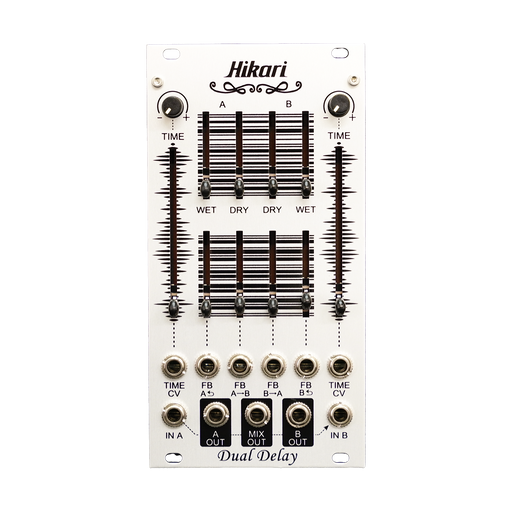

Hikari Instruments Dual Delay
In Stock¥33,000 (Tax excluded ¥30,000)Adopted PT2399 that produces a classical echo.VC dual delay with channel-to-channel feedback pathMUSICAL FEATURES Dual Delay is a two-channel delay module based on the PT2399 IC chip that has been used in many delay classics.Based on the PT2, a delay IC with a distinctive analog sound, the Dual Delay produces a classic echo sound...
details -


Hikari Instruments Gate SEQ
In Stock¥22,000 (Tax excluded ¥20,000)Compact gate sequencer with pause input and stage-by-stage gate outputMUSICAL FEATURES Gate SEQ is a compact toggle-switched 8-step gate sequencer.It features a gate output for each stage and a PAUSE input to stop the progress of the clock.


Hikari Instruments Standalone Device
-


Hikari Instruments Monos CV
In Stock¥37,400 (Tax excluded ¥34,000)Control the frequency divider and modulation by operating the slider.Tabletop synthesizer that produces a variety of noise texturesThe MUSICAL FEATURES Hikari Instruments Monos CV is a stand-alone synthesizer that offers a novel combination of noise generator and low-pass filter.This unit, which can generate various tones and textures by filtering and frequency division, has a built-in modulator ...
details -
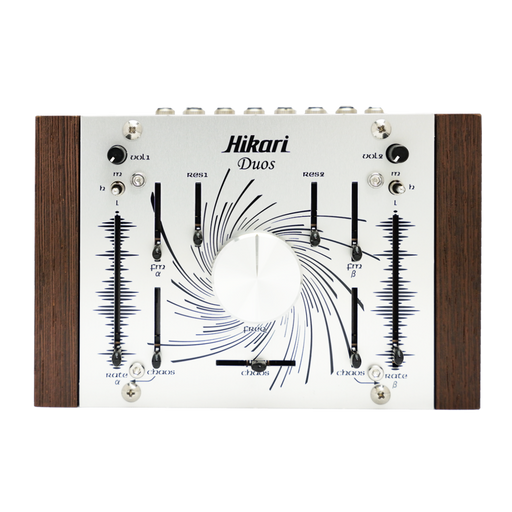

Hikari Instruments Duos
In Stock¥41,800 (Tax excluded ¥38,000)A unique chaos circuit produces a wide variety of soundscapes. Stereo chaos synthesizer with CV input / outputThe MUSICAL FEATURES Hikari Instruments Duos is a chaos synthesizer with two resonant low-pass gates.A chaos circuit consisting of a shift register and multi-feedback is a blizzard-like sound barrier with zero visibility, and a runaway mother computer-like pal ...
details -
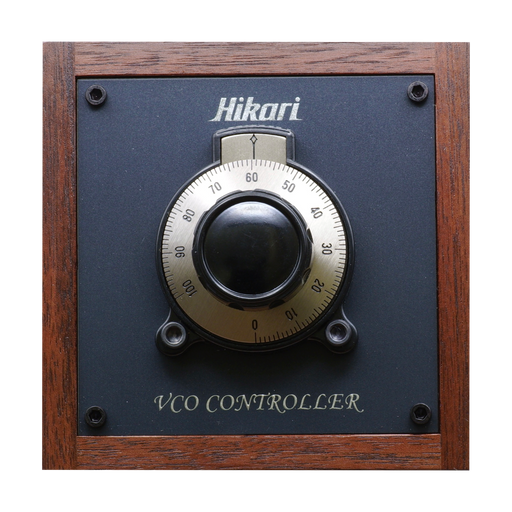

Hikari Instruments VCO Controller
In Stock¥33,000 (Tax excluded ¥30,000)VCO/attenuator/offset device with precise control via vernier dialMUSICAL FEATURES VCO CONTROLLER is an analog oscillator that can output 4 waveforms. Accurate control is possible with 1V/Oct CV input, and it can also be used as a VC LFO by lowering the frequency with the range switch. The Attenuator section on the back is an attenuator/CV...
details -
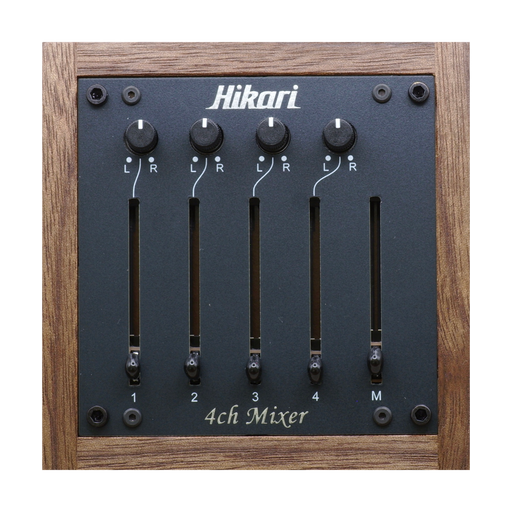

Hikari Instruments 4CH Mixer
In Stock¥29,700 (Tax excluded ¥27,000)4 mono inputs, compact standalone mixerThe MUSICAL FEATURES 4ch Mixer is an analog mixer with 4 mono channel inputs and stereo outputs. Each channel is equipped with a pan pot, allowing fine left and right volume adjustment. It also has a headphone output, making it easy to monitor the sound. The case is made of black wall...
details

